
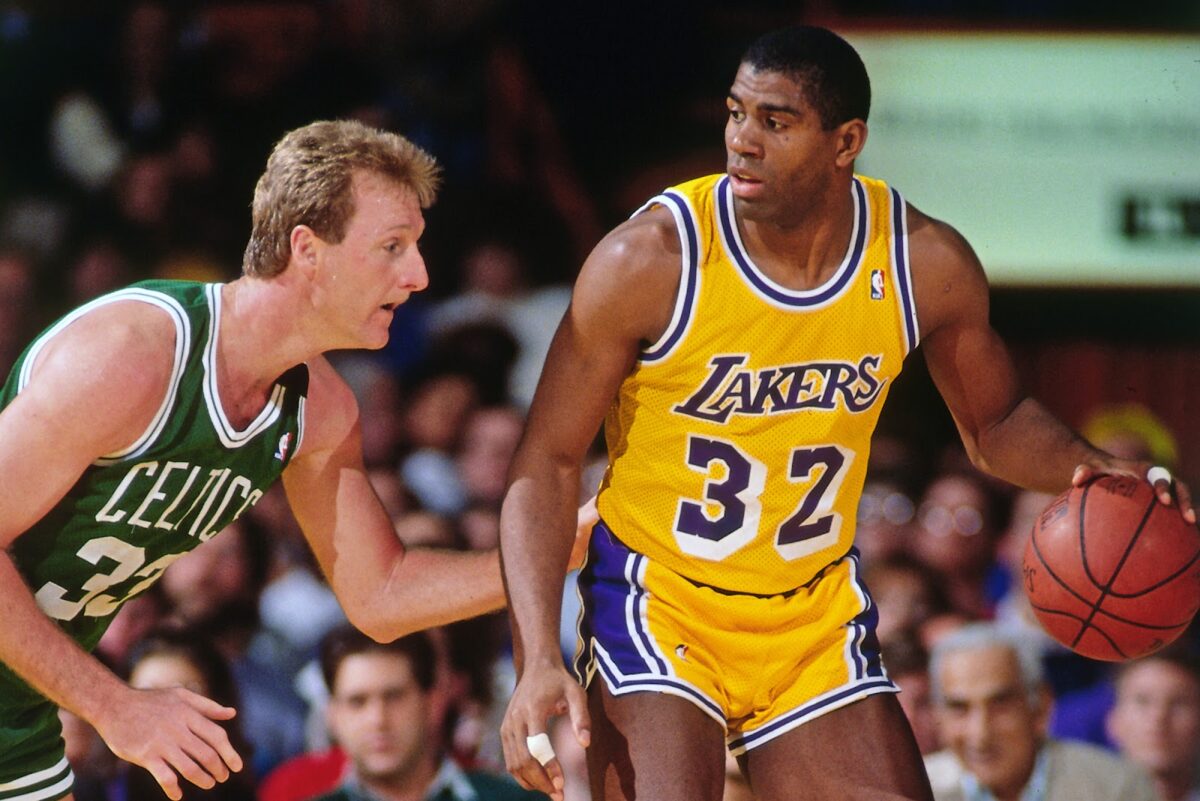
The 1980s could be named the decade of the revival of American pop culture and the beggining of the commercial cash-making machine which fueled infamous American consumerism. For something to be sold it had to be wrapped in colorful paper and served on a silver platter. The competition was immense, especially when it comes to TV air time which was already the most popular pastime for American citizens. In opposition, the government was strict, promoting yuppie culture and the economy was struggling – many people lost their jobs at the beginning of the 1980s and the crisis was touching upon already indigent communities.
Struggles of the NBA
At the beginning of the decade, NBA was still televised only on Sundays, but it changed with the rise of cable television. Even though cable was becoming more publicly available, the games didn’t enjoy high viewership. The NBA was in need of something that will bring the public attention, and they certainly got it.
Another problem of the NBA was that the game was thought of as being “too black” for Reagan’s conservative America. It was not only about the color of the skin, it was also about the aggressive gameplay. All of the players wanted to be a star, the next big thing, without further regard to winning championships. The pressure resulted in many NBA players turning into drug abuse. It painted a negative stereotype of black violent men, but the truth is, almost everyone was using drugs back then, no matter the skin color. Few exceptions, mentioned above, helped to restore a cleaner reputation for the NBA.
NBA Players
Nowadays, the 1980s are considered the greatest NBA decade by some. The gameplay was quick, the stars were on a rise and by the end, there were actually people to witness it. It is tempting to say that Michael Jordan single-handedly saved the NBA from further decline (and he definitely did that with the Bulls) but other superstars made the game worthy of watching. Some of the stories were so captivating that they gave the NBA needed attention outside the court and helped to create NBA culture.
Larry Bird vs Magic Johnson
The tale as old as the NBA says that every Boston Celtics player has to have the biggest Los Angeles Lakers rival. Bob Cousy had George Mikan, Bill Russell had Wilt Chamberlain and for Larry Bird, it was Magic Johnson.
The first time Magic Johnson saw Larry Bird it was on the cover of Sports Illustrated Magazine. Soon after, in 1978 they were chosen to represent team USA. They were polar opposites, with Magic craving for attention and Larry being quiet and focused only on the game. In 1979 they crashed in an NCAA game which officially started their rivalry. Magic Johnson stopped Larry Bird’s 33 games winning streak which sparked Bird’s appetite for revenge.

The rivalry arc was finished with both players achieving incredible success and getting a well-deserved spot in the Hall of Fame. Both of the players appeared in the famous 1986 Converse commercial.
Some say it was Michael Jordan who saved the NBA. I believe it was those two guys battling it out both on and off the court.
Larry Bird
Larry Bird joining the Boston Celtics was something that brought the team to its old glory. Along with Robert Parrish and Kevin McHale, they made an amazing trio, which was a power to beat in the decade. His first regular season with the Celtics is considered to be one of the greatest single-season campaigns. The Boston Celtics were crowned three-time NBA finals champions in 1981, 1984, and 1986.
Wolf in Sheep’s Clothing
Larry was calm, collected but at the court, he fought for the ball like there was no tomorrow. His rough style of gameplay earned him the respect of other players, who thought before that it’s impossible for a white guy to excel at basketball.
To the long list of team achievements, Larry Bird can add loads of individual ones, like averaging 23.6 points per game. He was selected into the NBA All-Star teams twelve times, he became NBA Most Valuable Player three times and in three consecutive years, and two time NBA finals MVP!
Magic Johnson
Magic Johnson joined the Los Angeles Lakers who were in a need of revival. Their star player, Kareem Abdul Jabbar was very talented but he couldn’t make up for the rest of the team, their gameplay was lacking in vitality. And Johnson was everything they needed, he was so talented, sometimes he played all five positions at once. He is a five-time NBA champion (1980, 1982, 1985, 1987, 1988), he is three-time MVP and three-time NBA Finals MVP.

Quick Rise to Stardom
Magic quickly became a celebrity- almost from the start of his college career thanks to his outgoing personality and incredible charm. He was always smiling and willing to talk with any reporter who was willing to ask him some questions.
James Worthy
James Worthy, better known as “Big Game James,” was at his finest in the clutch and when the game was on the line, a 6 ft 9 inch, 225-pound forward for the Lakers who ran the floor with speed and agility. Worthy was a two-time All-American who led North Carolina to an NCAA championship in 1982 and was named Final Four MVP. He led the Los Angeles Lakers to three championships, four Finals appearances, and seven NBA Finals.
Michael Jordan
To this day the Portland Trail Blazers are probably kicking themselves for not drafting Michael Jordan. In 1984 he was the third overall pick for the Chicago Bulls, a team that will become one of the greatest in league history in just ten years time. From the first year, his talent was obvious and he was used as a poster boy of the NBA. Older players, like Isiah Thomas, weren’t so keen to give up the spotlight, making Jordan’s road to victory a very hard one.
In the dawn of the 1980s, the Chicago Bulls were absolutely beaten by the Detroit Pistons, mentally and psychically. It didn’t stop Jordan from getting two scoring titles in 1988 and 1989. The Chicago Bulls were growing in strength which is important to remember because it projected onto the next decade as well.
Isiah Thomas
Isiah Thomas was drafted for the Detroit Pistons, who were a rather unsuccessful team before the 1980s, by 1985 becoming a striking force in the league. Isaiah Thomas is regarded as one of the greatest small guards in NBA history. Thomas was famous for his ability to go up against any opponent, large or little, and score without fear.

Along with Joe Dumars, Rick Mohom, Dennis Rodman, John Salley they created a “Bad Boys Club”. Their gameplay was exactly what white preppy America was scared of, focused on player size strength, full of violence. The Detroit Pistons literally and figuratively beat up their opponents during games. Although people don’t give him enough credit, Thomas can brag about beating Magic, Bird, and Jordan all in their primes.
Dominique Wilkins
The 19080s were the rise of another star, a Slam Dunk Champion Dominique Wilkins. Wilkins was a showman who electrified fans with his windmill dunk and all-out effort. The “Human Highlight Film,” as he came to be known, was an artist with elegance, power, and purpose, whether going through someone or over someone.
His style battles fought above the rim with Michael Jordan were legendary. Through the decade he teamed up with the Atlanta Hawks after rejecting a position in the Utah Jazz, who were struggling with financial problems. Dominique Wilkins averaged 24,8 points per game, with an impressive number of rebounds and assists.
Moses Malone
Few players in history have dominated the low block as effectively as the towering center out of Petersburg High School. He was the first modern player to skip college and go straight to professional basketball. Starting as a pro in the American Basketball Association, Moses Malone was no stranger to harsh gameplay.
Originally drafted by the Houston Rockets, he was traded to the Philadelphia 76ers in 1983. His individual achievements were enough to transform a rather average team. Malone led the 76ers to win the championship against the Lakers. Moses went out to become three-time NBA MVP and was selected to All NBA First Team four times.
Karl Malone
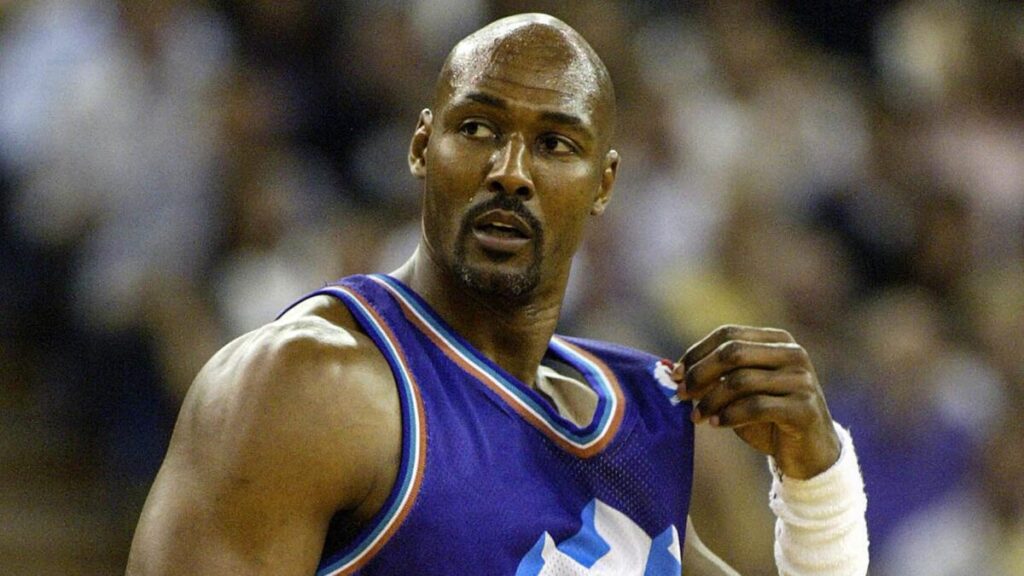
In 1985 Karl Malone graced the NBA with his presence. An elite scorer was selected by the Utah Jazz as the 13th overall draft pick. Malone was the two-time NBA MVP, and he received All-NBA First Team honors for an incredible eleven seasons, beginning in 1989. Malone averaged 25 points per game and scored 36,374 career points (which was second only to Kareem Abdul-Jabbar) when he was inducted into the Hall of Fame. At some point in his career, he had one game against his brother, something that hasn’t happened in the NBA before.
Alex English
During the 1980s, Alex English was one of the most respected and well-rounded players in the league. He was a coaching ideal: confident and quiet, teachable and prepared, and always eager to play. He was a saving grace for the Denver Nuggets, an integral part of the Nuggets fast-paced offense. He set 31 of the teams’ records, one of them being points per game record.
NBA Finals
In the 1980s, the NBA finals started to be more predictable and old dynastic teams regained their position in the roster with few other honourable mentions.
1980 – Los Angeles Lakers won the battle for the crown with Philadelphia 76ers.
1981 – Boston Celtics won the NBA Finals against the Houston Rockets.
1982 – Los Angeles Lakers crushed Philadelphia 76ers again!
1983 – Los Angeles Lakers were beaten by the Philadelphia 76ers this time around.
1984 – Los Angeles Lakers fell short to the Boston Celtics for the NBA title.
1985 – Los Angeles Lakers won their NBA Finals rematch with Boston Celtics.
1986 – Houston Rockets were swept away by the Boston Celtics.
1987 – Los Angeles Lakers again victorious in the battle for the NBA title over the Boston Celtics again.
1988 – Los Angeles Lakers beat the Detroit Pistons.
1989 – Detroit Pistons won against the Los Angeles Lakers.
All-Star Weekend
Televising All-Star Weekend was a great marketing move by the NBA administration. It gave the public what they wanted, flashy battles, the crashes of titans, and everything in the pompous coating. In 1986 Slam Dunk Contest was broadcast live for the first time in NBA history, later giving an opportunity for Michael Jordan to establish himself as a heartthrob of the US.
NBA History
As a decade, the 80s were an incredible part of NBA history. Franchises that were dying out were saved by enormously talented players who had the star factor. The greatest names of the 1980’s are still some of the most popular players and some of the younger fans would trade all of their NBA merchandise to go back to this time and watch their favorite players in action, battling it out in the NBA finals!
How many NBA championships did the Lakers win the 1980’s?
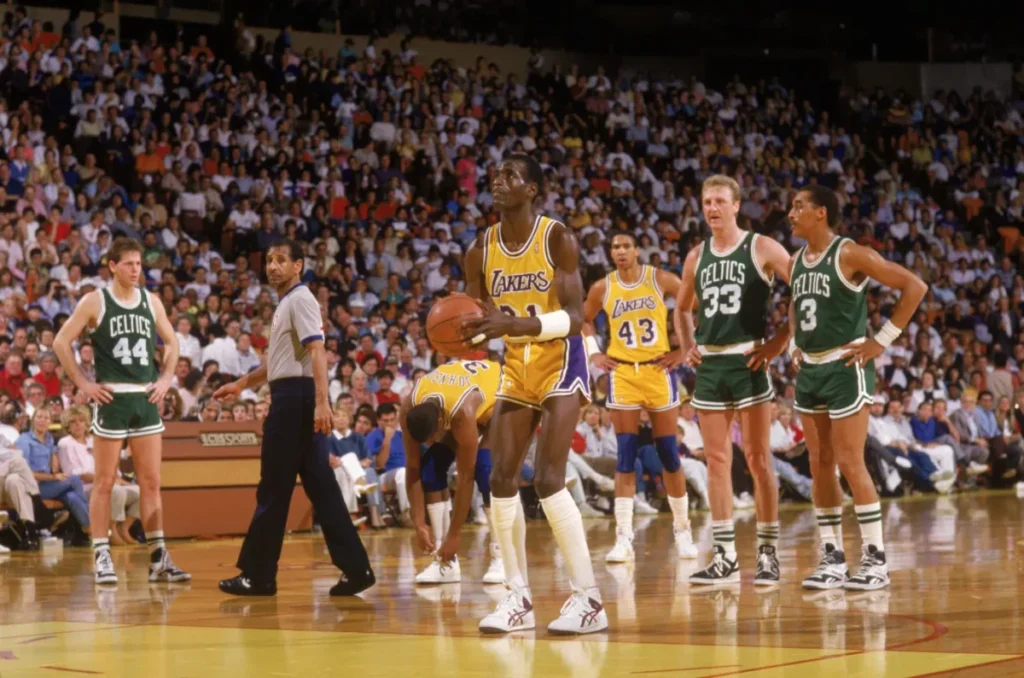
The “Showtime” Lakers, led by superstars Magic Johnson and Kareem Abdul-Jabbar, won five NBA titles during the 1980’s.
Who are the best NBA players in the 80’s?
With a combination of breathtaking dunks, incredible passing plays and supreme defensive ability from its legendary stars such as Michael Jordan, Magic Johnson, Larry Bird or Kareem Abdul Jabar just to name a few; it is no surprise that these players remain revered as some of basketball’s greatest icons even decades later.
When did the NBA get 30 teams?
The league expanded to 30 with the present New Orleans Pelicans joining in 2002.
Who scored the most points in the NBA in the 80’s?
During the 1980s, Alex English was the NBA’s most prolific point-producer, retiring as the seventh-highest scorer in history with an impressive 25,613 points.


