
During the past, present and future of basketball, there will always be a place to marvel at players who have one amazingly elite singular talent. Watching someone effortlessly pull up off the dribble and connect on a three pointer is a skill to cherish. Observing a player’s unmatched athleticism and positioning when it comes to pursuing a loose ball or a rebound can always be appreciated. Comprehending the type of vision a playmaking guard has when they anticipate and locate a teammate that is on the other side of the court is also very rewarding.
There are National Basketball Association greats who have individual traits that make them legendary, and then there are players who can revolutionize a sport by doing everything well. Oscar Robertson qualifies in the latter category. He was the first player in NBA history who was a superstar because he could beat you as a scorer, passer or rebounder. There’s also a chance his career would’ve been looked upon even more favorably had defensive statistics been kept during his prime. Oscar Robertson will forever be NBA royalty because of the remarkable template he set for future NBA stars.
Oscar Robertson – Childhood
On November 24, 1938 in Charlotte, Tennessee, Oscar Palmer Robertson was born. While his story starts in Tennessee, he would spend his formative years growing up in Indianapolis, Indiana due to a decision made by his parents Mazell Bell Robertson and Bailey Robertson, Sr.
Life was not easy for the Robertsons, despite their hope that it would be a little bit further north. They lived in a housing project that was segregated for African-Americans. The family did not have a lot of money, and could not afford to spend lavishly on sports equipment. As a result, Oscar Robertson would have to make do with what he had. He started to become interested in basketball, but there was one problem; he didn’t own one, nor could he buy one.
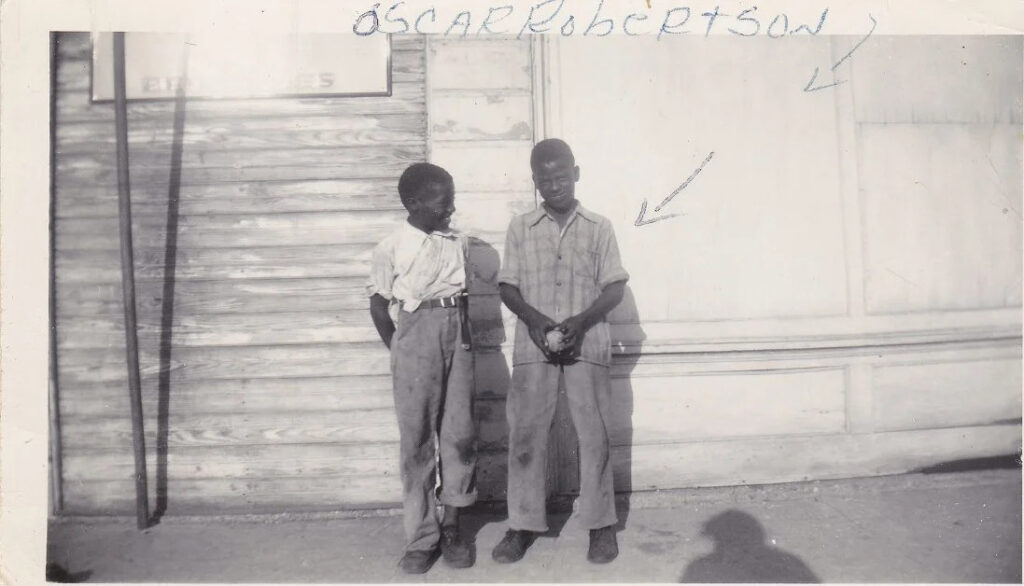
To get by, Robertson would practice his shooting form using tennis balls, or would simulate the size of a basketball by covering them with bunched up rags. Rubber bands would hold everything together, and he would aim for peach baskets, laundry baskets, trash cans—anything that would simulate a shoot around in the comfort of his own home.
When he got a little bit older, Robertson would play basketball on dirt courts around the city against his brothers and other children from the neighborhood.
Oscar Robertson – High School
Resources would not be much better for Robertson even as he entered high school. He attended Crispus Attucks High School, which had a number of students who were interested in playing basketball. However, the building had no gym, which it made it difficult for organized games to get off of the ground.
Thanks to the resilience of the students, and a new coach named Ray Crowe, a basketball program started to take shape. At first, the team founded at the all African-American school had difficulty finding anyone to play, because white basketball teams did not want to be involved in the games. Eventually, their stance was changed, but the Crispus Attucks basketball team would still have to play every one of their games on the road. Given the level of outward racism in the United States at that time, it would be a daunting task to endure for every member of the roster.
Even though they heard all kinds of demeaning words from the stands at their games, Robertson and his teammates let their play do the talking. Thanks to Robertson’s incredible talent and coach Crowe’s emphasis on teaching the fundamentals, Crispus Attucks dominated Indiana high school basketball in the mid 1950’s. They won two consecutive state championships in 1955 and 1956, and reeled off an incredible 45 straight wins in the process over that span. For his efforts, Oscar Robertson was named “Mr. Basketball” for the state of Indiana in 1956, which would boost his national profile.
After their exhilarating victories, the city would not let the team celebrate in Indianapolis. Officials were afraid that African-Americans would loot downtown, so they were forced to enjoy their victory elsewhere. It was an unfortunate decision made by the town, but Robertson proved in no uncertain terms that he belonged.
Oscar Robertson – College
Throughout his career and his life, Oscar Robertson continued to rewrite history. Things were no different when he set foot on campus at the University of Cincinnati. The Bearcats men’s basketball program had always featured exclusively white teams for the entirety of their history, and they were not alone in that regard during that time. When Robertson joined the team for the 1957-1958 season, he became the first African-American player to ever suit up for the Bearcats.
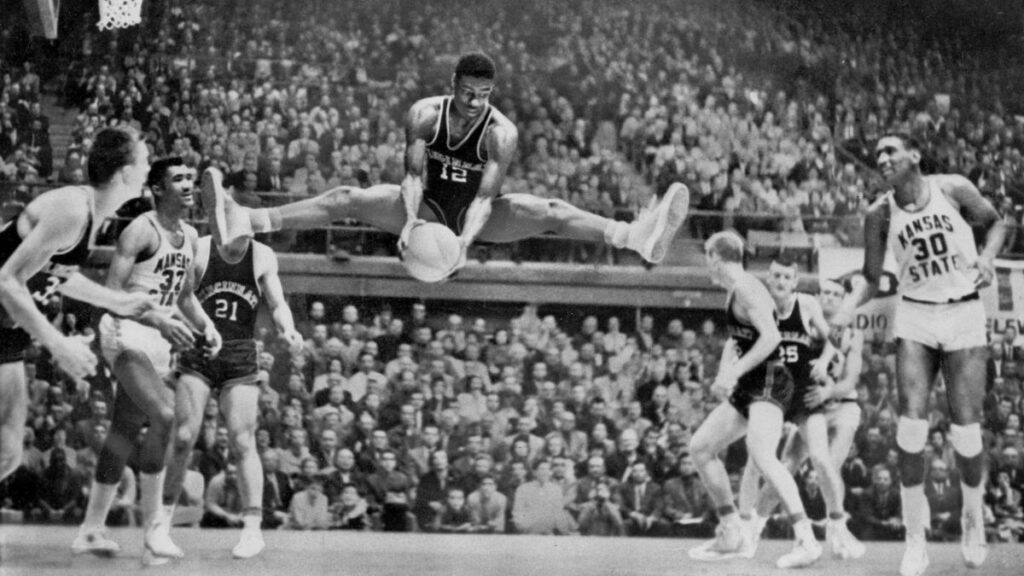
Not surprisingly, his arrival coincided with the beginning of a glory period for Cincinnati men’s basketball. As a freshman, Robertson averaged an astounding 35 points per game, to go along with over 15 rebounds per contest as documented on sports reference llc. There was nothing anyone could say about the young man with regards to his ability and deservedness to compete against the very best.
Cincinnati advanced deep into the postseason during each of Robertson’s three years at the school. They made it to the national semifinal round in his each of his final two seasons. He would play his best during the biggest games, scoring 56 points in a high profile matchup at Madison Square Garden. The court appeared to be his sanctuary, as off the court he would often have to stay in different living quarters than his teammates due to rampant segregation.
The Big O would end up receiving all sorts of individual accolades for his play, including College Player of The Year and All-American status. When his three-year Bearcats career was over, he left the college game as the NCAA’s highest scorer.
Oscar Robertson – International Achievements
Before he would take his immense talents to the NBA, Oscar Robertson needed to make one stop in Rome. This was where the 1960 Olympic Games were being held, and he was named a co-captain on the United States men’s basketball team.
The roster included other legendary players like Jerry West, Jerry Lucas and Walt Bellamy. They had no trouble getting past their competition, finishing with an 8-0 record on their way to the gold medal. Robertson averaged 17 points per game during the tournament.
Oscar Robertson – Cincinnati Royals
When he became NBA Draft eligible in 1960, there wasn’t much suspense surrounding where Oscar Robertson might start his professional career. That was because in the early days of the NBA, there was a system in place known as territorial drafting. This was implemented to allow teams to be able to pick star prospects who were already shining in their home markets. The logic behind it centered around fans being familiar with a college star who they were previously watching, reading about, or bumping into around town.
With this in mind, the University of Cincinnati star was destined to play for one team; the Cincinnati Royals. Robertson was an instant star for a team that badly needed one. The Royals had missed the postseason in four out of the last five seasons before The Big O got there.
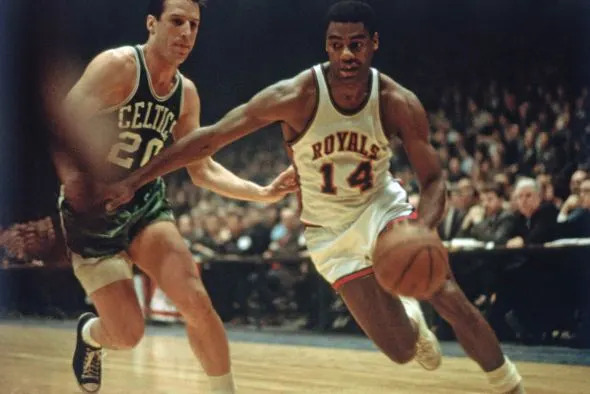
The 1960-1961 Rookie of The Year award was won by Oscar Robertson, and there wasn’t much doubt who would take home those honors once the season started. In his first year in the NBA, he averaged 30 points, 10 rebounds, and just a shade under 10 assists. The fact that he could come right in and do everything at that level was truly special, and he nearly had a record setting season right off the bat.
The campaign that everyone would talk about for decades occurred in Robertson’s second year in the league. In 1961-1962, he averaged over 30 points per game, 12 rebounds per game and over 11 assists per night. That of course, is a triple double, which basketball fans of this generation know any time they see it. However, back in those days, the moniker for the statistical achievement was not all that popular. Robertson did not think too much about the historical individual production he put forth that season since there wasn’t really a way to qualify what he had done. He has since said that his focus had always been on winning, although he was proud of being able to do something that no player had done until Russell Westbrook in 2016-2017.
Although Robertson’s statistics were phenomenal in each one of his Cincinnati Royals years, he only won one MVP award, in 1963-1964. That might seem somewhat surprising on the surface, but he did play in an era with other greats like Jerry West and Wilt Chamberlain. For that reason, it was also difficult for the Royals to break through in the playoffs due to the level of competition they would face. They made the Eastern Division Finals in 1962-1963 and 1963-1964, but lost both times to the likes of Bill Russell, Bob Cousy, and the Boston Celtics.
Like many stars that would come after him, Robertson gave his all trying to deliver a championship for the first franchise that brought him into the league, but he came up just short. Ironically, the future Hall of Famer would end up playing for one of his nemeses in the decade during his final year in Cincinnati. Bob Cousy was the head coach of the Royals in 1969-1970, but his winning ways as a player did not translate on the bench, as the Royals missed the postseason.
Oscar Robertson – Milwaukee Bucks
Almost ten years to the day that Oscar Robertson became a Cincinnati Royal, he was traded to the Milwaukee Bucks. The franchise would experience several more losing seasons under Cousy before eventually moving to Kansas City.
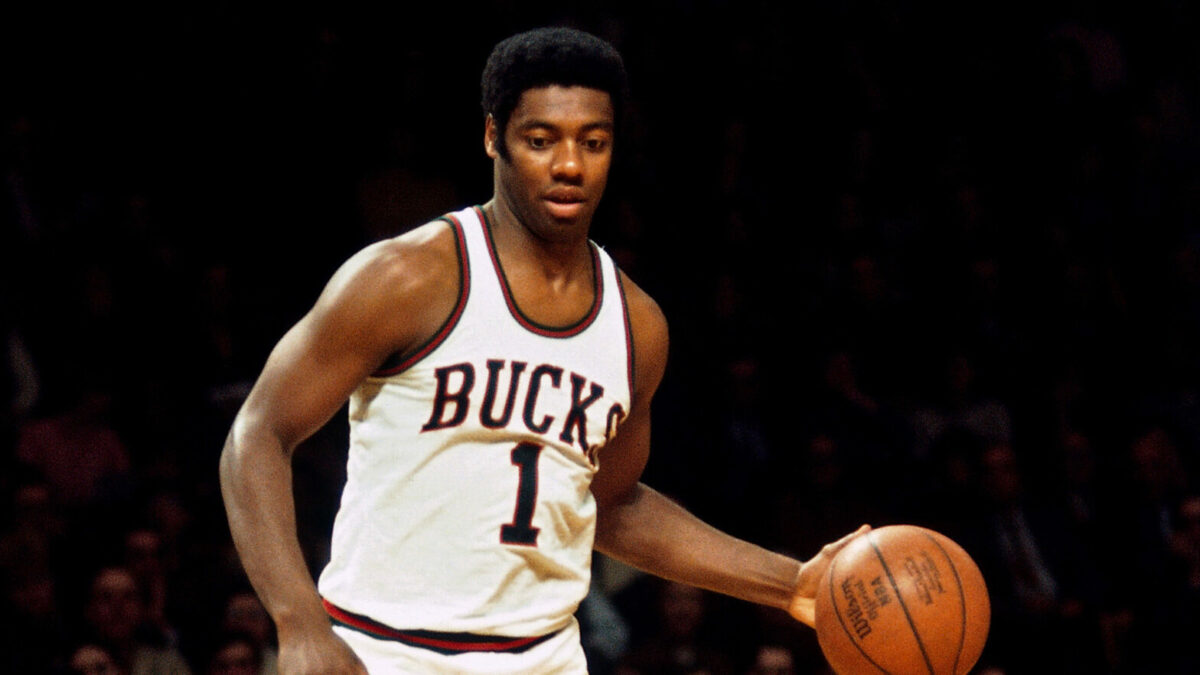
It turned out to be just what Robertson would need to validate and revitalize his career. He would get a chance to play with a young Kareem Abdul-Jabbar, who like him, took very little time to make a name for himself in the NBA. It was the perfect pairing, as Robertson was still good enough to control the perimeter, while Abdul-Jabbar would dictate play in the paint.
The All-Star tandem would run circles around the league in their first year together in 1970-1971, winning 66 regular season games. It was pretty telling that Robertson averaged career lows in almost all the major counting statistical categories, but achieved team success like he had never experienced before in Cincinnati.
In the postseason, the Bucks did not get much resistance, as they defeated the San Francisco Warriors and Los Angeles Lakers four games to one in each of the first two rounds. In the NBA Finals, they made quick work of the Baltimore Bullets, sweeping the series en route to the franchise’s(and Robertson’s) first NBA championship.
Milwaukee would remain a championship contender for the remaining three years of Robertson’s career. While he did not qualify for the NBA All Star Game is his final two seasons with the Bucks, Robertson and his teammates had built a winning culture that allowed them to thrive.
During the former Bearcats’ last season in the league, the Bucks would make one last strong push to get The Big O his second ring. They would have another exemplary regular season in 1973-1974, winning 59 games and finishing first in the Midwest Division. They got past the Los Angeles Lakers and Chicago Bulls in the first two rounds, setting up a showdown with the team Robertson could never get past in Cincinnati; the Boston Celtics.
The teams would alternate wins in the first six games of the title series, which meant that the championship would come down a deciding seventh game. Unfortunately, Robertson only shot 2-13 from the field in Game 7, but did have 11 assists will playing 46 minutes. His playmaking in what would be his final NBA game would not be enough, and Boston won the NBA title.
Oscar Robertson – Naismith Memorial Basketball Hall of Fame
All in all, it is hard to deny the type of impact that Oscar Robertson had on the game of basketball. What sometimes gets lost in the narrative of his prodigious scoring, rebounding and assist totals is how efficient he was. As a guard, he shot over 48 percent from the field, and complimented that by shooting nearly 84 percent from the free throw line. There was almost literally nothing a defender could do to limit Robertson’s impact on the floor.
Additionally, he was instrumental in shaping the business of the league. Oscar Robertson was the president of the players association for several years, and was a main figure in the talks that ended up merging the ABA and the NBA. In 1976, Robertson also led the charge for what we know today as modern free agency. There were a lot of people in the game at that time who thought players should remain on teams for the duration of their career, but Robertson thought player leverage was important.
This year, the NBA announced that the team that wins the Western Conference each year will receive the Oscar Robertson trophy, further keeping his storied name relevant.
Oscar Robertson was inducted into the Naismith Memorial Basketball Hall of Fame in 1980.
Does Oscar Robertson have a ring?
For a while, it seemed like one of the greatest players in NBA history may not win a ring. Despite his stellar play with the Cincinnati Royals, Oscar Robertson’s teams never seriously challenged for an NBA championship. It became clear that he might have to change teams in order to win an elusive title. Ahead of the 1970-1971 campaign, Robertson joined the Milwaukee Bucks and Lew Alcindor/Kareem Abdul-Jabbar. Together, the pair was very difficult for the league to stop, as they won 66 games in the regular season. The Bucks also breezed through the playoffs, and Robertson won his only ring.
What was Oscar Robertson famous for?
Oscar Robertson was one of the greatest players in NBA history. He was most famous for his well rounded play, and bringing many different skills to the table as a guard. He could score, he was an excellent passer, as well as a tremendous rebounder. Perhaps the most popular career achievement he had was averaging a triple double for the entirety of the 1961-1962 season. He was the only player in league history to have accomplished that feat until Russell Westbrook of the Oklahoma City Thunder was able to do it in the 2016-2017 season. He also won a title with the Bucks in 1971.
Who was better Oscar Robertson or Magic Johnson?
It is very difficult to determine whether Oscar Robertson or Magic Johnson was a better player. They both played in different eras, with different challenges and advantages that they needed to deal with. At the end of his career, Robertson’s numbers are among the best any player have ever posted in league history. While Johnson’s numbers don’t quite stack up in most categories, he did win five championships, proving that he was able to guide his team to the promised land over and over. Robertson was only able to win one title over the course of his career. There is a case to be made for both players.


