
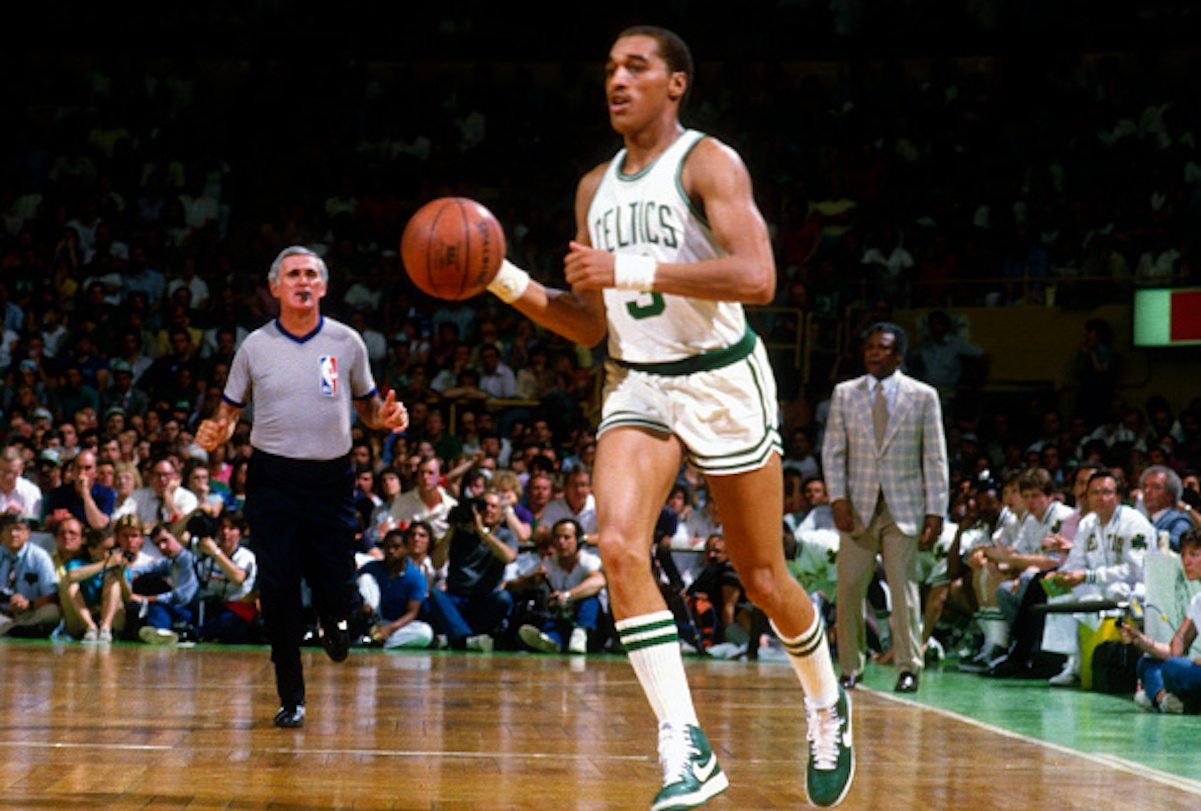
Dennis Wayne Johnson, better known as DJ, had a long and spectacular history in the NBA. He was the No. 29 selection by the Seattle SuperSonics in the 1976 NBA draft. The selection of Johnson will go down as a very impressive second-round pick for a franchise that never had won a championship in its history at the time.
DJ played at both LA Harbor College and Pepperdine before making the jump to the professional ranks. The guard played his first NBA season in 1976-77, and by his third season, he was already being recognized for his defensive prowess. He made the All-Defensive First Team in 1978-79, his first of six All-Defensive First Team selections. In total, he had five All-Star Game appearances and made nine All-Defensive Teams. In addition, DJ was the 1979 Finals Most Valuable Player, and he made the 1979-80 All-NBA Second Team and the 1980-81 All-NBA First Team.
The Hall of Fame guard joined Alex English as the only 1976 second-rounders to make the Naismith Memorial Basketball Hall of Fame. Unfortunately, he was not inducted while he was alive. DJ was posthumously inducted into the Hoop Hall of Fame. The other two inductees from the 1976 NBA draft were Adrian Dantley (No. 6 overall selection) and Robert Parish (No. 8). That is pretty good company for Johnson, so let us delve into his strong 14-year career.
Dennis Johnson – Seattle Supersonics
The Supersonics, who has since become the Oklahoma City Thunder to the dismay of many Seattle basketball fans, drafted the Hall of Fame guard, and he played four seasons in Seattle. DJ joined a franchise that had Boston Celtics all-time great Bill Russell as its head coach. Russell was the first coach to bring the SuperSonics to the playoffs. Unfortunately, the 1976-77 season with Russell’s last as the team’s head coach. The SuperSonics went just 40-42 that year and missed the playoffs.
NBA Hall of Famer Lenny Wilkens returned to coach Seattle, and he was able to build on the foundation created by Bill Russell. Wilkens, whose No. 19 jersey was retired by the SuperSonics franchise in October 1979, owned the NBA’s coaching wins record by the time he retired. Wilkens won one championship, and that one ring came in 1979 with the Sonics. It would not be the last for Dennis Johnson though.
Even though DJ — who would eventually win two more championships in his NBA career — experienced a coaching change, he was not deterred. In each of DJ’s four years in Seattle, he improved. He began with 9.2 points per game in his rookie 1976-77 season, and he then moved to 12.7, 15.9, and 19.0 points per game in the following three seasons. In addition, his assist and defensive rebounding numbers improved each year as well.
DJ showed early in his career that he would be an iron man for any team he would play for. In his four seasons in Seattle, he missed just five regular-season games. He saw his minute totals increase each year and took more responsibility, and as a result, he was an all-star in each of his final two years in Seattle: 1978-79 and 1979-80.
Dennis Johnson – His First NBA Championship
In Johnson’s third season — the first year in which he made an appearance in the All-Star Game — the Seattle SuperSonics were champions. Gus Williams (19.2 points per game), DJ (15.9 PPG), Jack Sikma (15.6 PPG), Fred Brown (14.0 PPG), John Johnson (13.5 PPG), and Wally Walker (11.0 PPG) all were important contributors for the 1979 champion Sonics.
After taking down the Los Angeles Lakers and Phoenix Suns in the first two rounds of the playoff, the Sonics defeated the Washington Bullets to win the NBA championship in five games. DJ averaged 22.6 points, six rebounds, and six assists per game en route to the 1979 NBA Finals MVP Award. Johnson led the Sonics with nine field goals made in the series-clinching 97-93 Game 5 victory.
Also, the 1978-79 season marked the first time that DJ made an All-Defensive team. In addition, he had a top-20 defensive win share season that year. Johnson would be in Seattle for just one more season after the championship year though. Then during the 1980 offseason, the SuperSonics traded DJ to the Phoenix Suns for Paul Westphal.
Dennis Johnson – Phoenix Suns
DJ’s Phoenix Suns tenure was surprisingly shorter than his time in Seattle. The Suns were playoff teams each of the three years that he was there, but unfortunately, they never made it past the Western Conference Semifinals. John MacLeod’s Suns played great defense, but the Los Angeles Lakers, Houston Rockets, and San Antonio Spurs reigned supreme in the Western Conference.
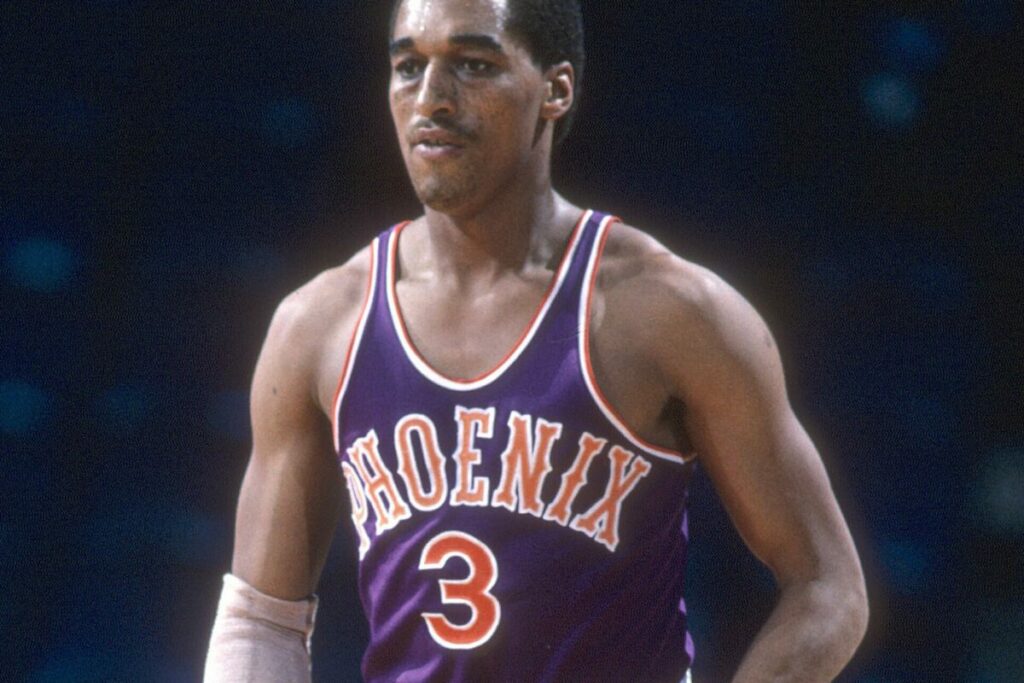
Even with the Suns’ playoff struggles, Johnson was an all-star in each of his first two seasons in Phoenix. DJ made the All-Defensive First Team in both years as well. In 1980-81, he averaged at least 18.8 points, 4.6 rebounds, and 3.7 assists per game. Then, he improved in 1981-82 with 19.5 points, 5.1 rebounds, and 4.6 assists per contest. The 19.5 points per game were his career-high.
Although it was just not meant to be for the Suns in terms of championships, DJ’s defense continued to be top-notch, and that must have been the reason why he was coveted by Red Auerbach and the Boston Celtics. Just over three years after the Suns acquired DJ, they traded him to the Celtics. Phoenix acquired Rick Robey and two second-round selections, while Boston received Johnson, a first-round pick, and a third-round selection in return. The trade was completed the day before the 1983 NBA draft, and all of the selections were part of the 1983 draft on June 28.
Dennis Johnson – Boston Celtics
The Celtics made one of their best trades in franchise history when they acquired Johnson. During DJ’s Celtics career, he was a part of a team that made perennial noise in the playoffs. Hall of Famer K.C. Jones, who unfortunately passed away on Christmas 2020, coached the Celtics from 1983-84 — DJ’s first year with the Celtics — to 1987-88. Additionally, Johnson was fortunate to play with Boston’s original big three: Larry Bird, Kevin McHale, and Robert Parish.
Dennis Johnson – Second NBA Championship
After going 62-20 in 1980-81, the Celtics were champions in Larry Bird’s second season. However, Boston did not make it to the NBA Finals in the following two years. Then in DJ’s first season, the Celtics again went 62-20 in 1983-84, which was K.C. Jones’ first of three 60-win seasons as the team’s head coach. Johnson would be on each of those three teams.
Although DJ was new to Boston in 1983-84, he was a major piece to multiple championship puzzles. In the 1984 playoffs, Larry Bird led the top-seeded Celtics to the NBA Finals against the best team in the West, the Lakers. Dennis Johnson had a tremendous performance in Game 7 of the NBA Finals, as he made all 12 of his free throws and scored 22 points. Cedric Maxwell — the 1981 NBA Final MVP — continued producing in the 1984 Finals: he scored a team-high 24 points in the 111-102 series-clinching win, and the Celtics won their 15th title in franchise history.
Dennis Johnson – Third NBA Championship
Unfortunately for DJ and company, the Celtics dropped the 1985 NBA Finals to the Lakers, but the 1985-86 Celtics were back and better than ever. This Celtics team is often thought of as the best team in franchise history. Led by their strong defense, the 67-win green squad could not be stopped in the postseason. Heading into the 1986 Finals, the Celtics lost just one game, an Eastern Conference Semifinals contest to the Atlanta Hawks.
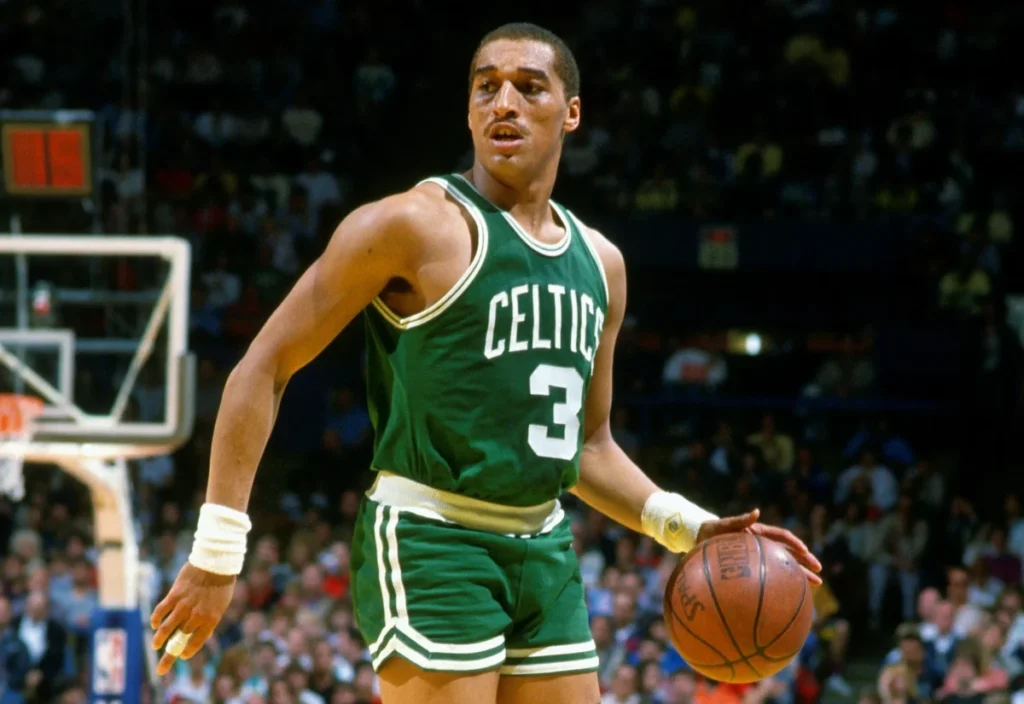
The 1986 Celtics played in the NBA Finals against the Houston Rockets, who had yet to win a championship in franchise history. After a 51-31 season in which the Rockets won the Midwest Division, head coach Bill Fitch — who was the head coach for the 1981 Celtics championship team — coached Houston to the Finals. The Rockets lost just three games heading into the championship series against Boston.
However, Houston ran into a buzzsaw. Even after setting a new franchise record at the time with 51 wins, the Rockets could not handle the Celtics on the defensive end: they allowed the Celtics to have a field goal percentage of at least 56 percent twice. The green went 4-0 in the Finals when shooting 49 percent or better. Finals MVP Larry Bird dominated with 24 points, 9.7 rebounds, 9.5 assists, and 2.7 steals per game. DJ did pretty well himself with 17.0 points, 6.2 rebounds, 5.3 assists, and 2.0 steals per contest, and those all ranked top five on the team.
“Now There’s a Steal by Bird!”
In the 1987 Eastern Conference Semifinals, Johnny Most, the Celtics radio commentator, described one of the most important moments in NBA history: “Now there’s a steal by Bird! Underneath to DJ, who lays it in! Right at one second left! What a play by Bird! Bird stole the in-bounding pass, laid it up to DJ, and DJ laid it up and in, and Boston has a one-point lead with one second left!” With that game-sealing Bird steal and DJ made lay-up, the 1986-87 Celtics went on to win the Eastern Conference Semifinals. The Celtics would defeat the Pistons in the conference finals but would lose the Finals in six games to the Lakers.
Johnson and the Celtics made the Eastern Conference Finals in 1988 before a couple of first-round losses. Then, DJ retired from the NBA in 1991, and very soon after, the Celtics franchise was ready to retire his No. 3 jersey. It was raised to the rafters on December 13, 1991. How fitting was it that the Celtics team that evening faced DJ’s first squad, the SuperSonics? Boston defeated Seattle, 117-97, that evening.
The 1991-92 Celtics would finish with the Atlantic Division’s best record that season. Celtics head coach Chris Ford had his best season in 1990-91 (56 wins), but then saw a decline with 51 wins in 1991-92, 48 victories in 1992-93, and a lowly 32 wins 1993-94. The Celtics franchise had a very difficult time bouncing back during the 1990s. They missed the playoffs in 1994 in addition to every postseason from 1996 to 2001.
Dennis Johnson – Johnson’s Coaching Career
DJ was an assistant coach for those struggling Celtics before he went to coach the La Crosse Bobcats of the Continental Basketball Association. Here is the rest of his coaching resume, including a couple of positions in the G League, which was then known as the NBA Development League:
- 1993 to 1997: Boston Celtics (assistant coach)
- 1999 to 2000: La Crosse Bobcats of the CBA
- 2000 to 2003: Los Angeles Clippers (assistant and head coach)
- 2004 to 2005: Florida Flame of the NBA D-League
- 2005 to 2007: Austin Toros of the NBA D-League
Did Dennis Johnson pass away?
Sadly, Dennis Johnson passed away on February 22, 2007. He had a heart attack after an Austin Toros practice at Austin Convention Center in Texas. He was 52 years old. It was very unfortunate to see him go so early.
Was Dennis Johnson a good defender?
He would end up being enshrined in the Naismith Memorial Basketball Hall of Fame in 2010. He was one of the best defensive players in NBA history, as he made nine consecutive All-Defensive Teams. He also was a clutch postseason player and won three championships. Dennis Johnson will always be remembered for his greatness.
What college did Dennis Johnson play for?
Dennis Johnson played for Pepperdine University. His fierce defense was unmatched on the court, yet he still managed to squeeze over 15 points per game during his one year stint at Pepperdine.


