
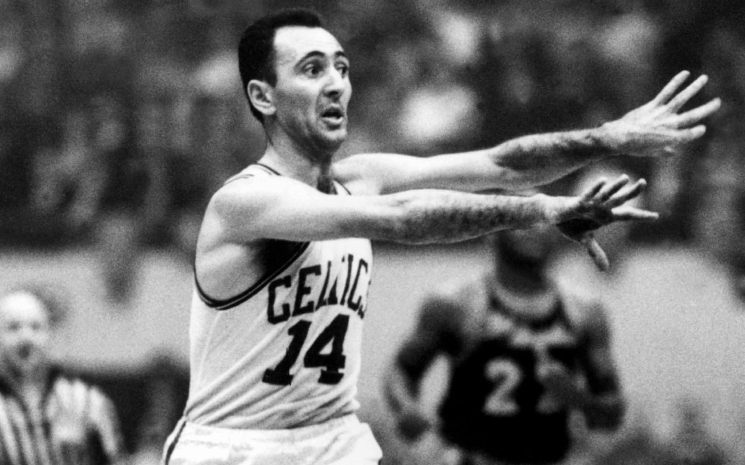
From 1950 to 1963, Bob Cousy and the Boston Celtics were synonymous. Robert Joseph Cousy was a Celtics legend, with his No. 14 hanging in the rafters at TD Garden. In 2021, the “Cooz” celebrated his 93rd birthday, and Celtics fans always get excited to see one of the team’s original legends. Not only was he an impressive player for the green in the NBA, but he was also a very impressive college basketball player for the Holy Cross Crusaders. His No. 17 jersey was also retired by Holy Cross.
Cousy’s accolades are seemingly endless. Let us start with college: he was a 1947 NCAA champion, 1948 Third-Team All-American, 1949 Second-Team All-American, and 1950 consensus First-Team All-American. He also has a collegiate award named after him. Since 2004, the College of the Holy Cross has annually awarded the best point guard in college basketball with the Bob Cousy Award.
Then in the NBA, he was selected to the league’s 25th, 35th, 50th, and 75th-anniversary teams. He was one of just four players to be selected for each of the 25th, 35th, and 50th-anniversary teams. At the 2021 NBA All-Star Game, the league celebrated its 76 best players in league history, and Cousy was one of the players. He was also a six-time champion: in 1957 and every year from 1959 to 1963. Additionally, He has Most Valuable Trophy hardware from 1957. Cousy grabbed a couple of MVP awards in the All-Star Game as well: 1954 and 1957.
Cousy played 13 NBA seasons with the Celtics, and he was a 13-time NBA all-star. He was selected to 10 All-NBA First Teams and two All-NBA Second Teams. He led the NBA in assists per game every season from 1952-53 to 1959-60. In seven consecutive seasons (1950-51 to 1956-57), Cousy finished in the top 10 in points per game. Cousy also was a free-throw maven. In eight straight years (1951-52 to 1958-59), he was in the top 10 in free throw percentage. He also finished in the top 10 in free throw makes in five straight years from 1951-52 to 1955-56. Finally, Bob Cousy was awarded the Presidential Medal of Freedom on August 22, 2019.
Cousy had such a tremendous basketball career, and he will always be remembered by Celtics, Crusaders, NBA, and NCAA basketball fans. His ball-handling and passing were unbelievable, and he had such an impact on the Celtics franchise. Let us first begin with his college career though.
Bob Cousy -College Basketball Career with the Holy Cross Crusaders
Bob Cousy, who grew up in New York with his French parents, loved basketball as soon as he began playing it at Andrew Jackson High School in St. Albans. The Queens, New York native went to Holy Cross to play college basketball and could dribble very well with both his right and left hands after breaking his right hand in high school.
As one of six freshmen for the Crusaders for the 1946-47 season, Cousy came off the bench in his first year with Holy Cross. Head coach Doggie Julian’s strategy paid off, as the Crusaders were national champions in Cousy’s first season.
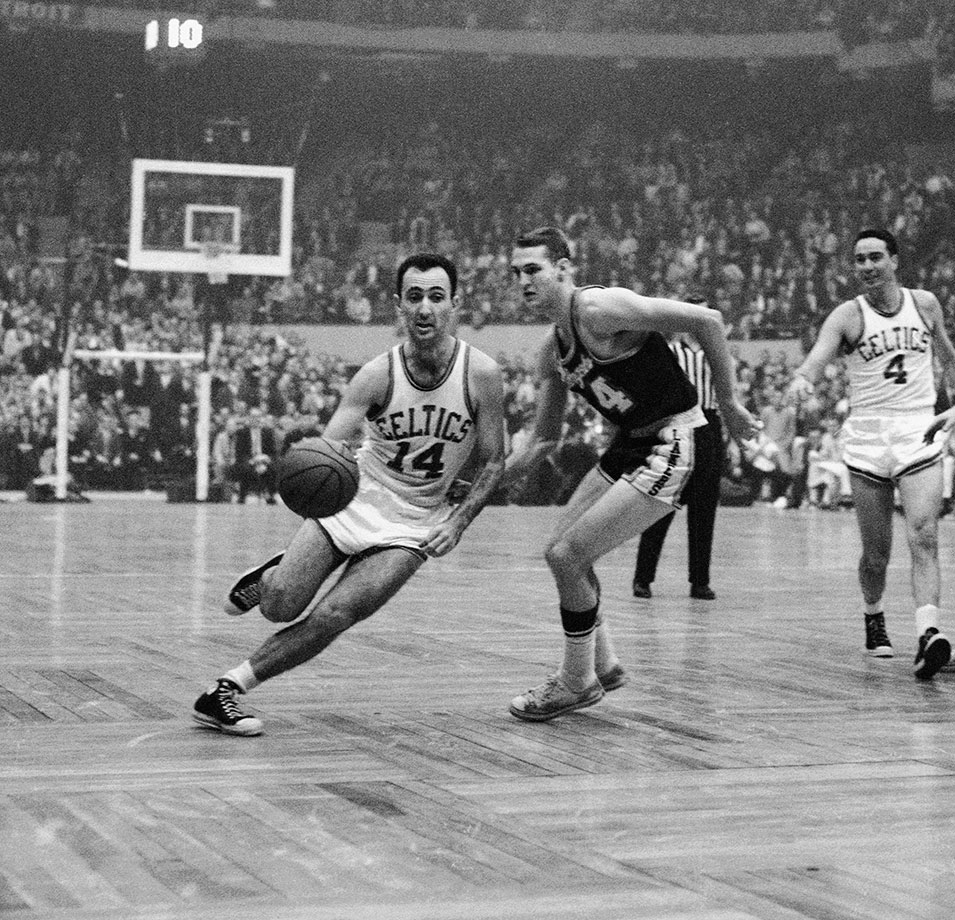
Unfortunately, Julian decreased Cousy’s playing time during his college career, and the future Hall of Fame guard contemplated transferring. However, that would mean that Cousy would have to sit out a season. Therefore, he decided to stay at Holy Cross for all four years. Who knew that Cousy’s college basketball career would change at Boston Garden? Early in Cousy’s senior year (1949–50), the crowd chanted in favor of Cousy entering the game late against Loyola of Chicago. Julian decided to do so, and Cousy won the game on a buzzer-beater shot.
Then, the Crusaders ran off 26 consecutive wins and enjoyed many impressive victories at Boston Garden. Unfortunately, Holy Cross did not enjoy NCAA tournament success that year, as they did not get a tournament win. After dropping games at both Columbia and Yale at the end of the regular season, the Crusaders lost to the North Carolina State Wolfpack in an opening round of the tournament at Madison Square Garden.
Bob Cousy -Boston Celtics
After four years of impressive basketball at Holy Cross, Bob Cousy entered the 1950 NBA Draft. Celtics head coach Red Auerbach ended up not selecting Cousy with the second overall pick in the draft. The Celtics drafted Chuck Share instead. Maybe it was the Celtics’ luck or that Auerbach knew something, but Cousy would end up on the Celtics.
Cousy, who was selected by the Tri-Cities Blackhawks with the fourth pick on April 25, 1950, decided to not play for the Blackhawks. Then on May 21, 1950, the Tri-Cities Blackhawks traded Cousy to Chicago Stags for combo guard Frankie “Flash” Brian. With another stroke of luck for the Celtics, the Chicago Stags folded, and then on October 5, 1950, the Boston Celtics drafted Cousy from the Chicago Stags in the dispersal draft.
The Cooz’s first season with the Celtics was also the first season with Red Auerbach as the team’s head coach. Bob Cousy, also known as the “Houdini of the Hardwood” — Auerbach’s nickname for him — was a large part of a Celtics team that went to the playoffs every year from 1951 to 1968. However, the first six years ended either in the Eastern Division Semifinals or the Eastern Division Finals. Cousy was getting his playoff experience though: he led the NBA in playoff scoring per game in 1953, 1954, and 1955.
Cousy had his career-high 21.7 points per game in the regular season in 1951-52, but his passing increased with almost every passing year. Here is how he performed in terms of passing in his first 10 seasons:
- 1950-51: 4.9 assists per game – fourth in NBA; second in NBA with two triple-doubles
- 1951-52: 6.7 – second in NBA; second in NBA with three triple-doubles
- 1952-53: 7.7 – led NBA; also led NBA with five triple-doubles
- 1953-54: 7.2 – led NBA; also led NBA with two triple-doubles
- 1954-55: 7.8 – led NBA; also led NBA with three triple-doubles
- 1955-56: 8.9 – led NBA; also led NBA with eight triple-doubles
- 1956-57: 7.5 – led NBA
- 1957-58: 7.1 – led NBA
- 1958-59: 8.6 – led NBA; also led NBA with three triple-doubles
- 1959-60: 9.5 – led NBA; second in NBA with four triple-doubles
Let us just say that the Houdini of the Hardwood could not be stopped, and that brings us to the many successful years of Celtics basketball. We start here with the 1957 NBA champion Boston Celtics.
Bob Cousy – 1957 NBA Championship
After many years of early exits in the postseason, Boston made its first NBA Finals in 1957. After sweeping the Syracuse Nationals, 3-0, in the Eastern Division Finals, the Celtics took on the St. Louis Hawks in the 1957 Finals. Hawks future Hall of Famer Bob Pettit scored 30.1 points per game in the Finals, as the Celtics and Hawks went to seven games. However, Celtics team basketball won the series. Boston received double-digit points per game from Tom “Tommy” Heinsohn (24.0), Bill Sharman (21.9), Cousy (20.7), Bill Russell (13.3), and Frank Ramsey (11.6) during the series. Russell dominated the boards to the tune of 22.9 rebounds per game, as the Celtics won the series in seven games.
With the 125-123 Game 7 victory, the Celtics were champions for the first time in franchise history. Cousy dished out a series-high 9.1 assists in addition to his impressive scoring. He also chipped in 6.7 rebounds per game. The first NBA championship for Cousy, Russell, Auerbach, and company was a special moment. There was more good news for the Celtics and their fans, as they were many more titles to come.
Bob Cousy – Five More NBA Championships
The Celtics pulled off a streak of 10 straight NBA Finals appearances, and Cousy was a part of seven of those attempts at a championship. Of the seven appearances for the Cooz, six were successful. By the time the Celtics had lost in the 1958 NBA Finals, Bill Russell had taken over the mantle as the Celtic with the highest number of win shares each year. He took over that mantle from Hall of Famer Bill Sharman, who won four championships. Sharman had taken over from Ed Macauley, who was a part of the 1958 championship team in St. Louis. The reason that Macauley was in St. Louis instead of Boston was that he was traded for Russell.
In 1958-59 and 1959-60, the Celtics set new single-season bests in wins with 52 in the former season and 59 in the latter. Boston finished at the top of the Eastern Division in each of those years, as a part of a nine-year streak of division domination. In both 1958-59 and 1959-60, the green was the best team in the league in many statistical categories.
Cousy was the second-leading scorer for both the 1959 and 1960 champion Celtics teams. Bill Sharman led the team with 20.4 points per game in 1959 — Cousy had 20.0 — while in 1960, Tommy Heinsohn had 21.7 points per game and Cousy had 19.4. In the 1959 playoffs, the Cooz’s passing could not be stopped, as he dished out 10.8 assists per game, which was the most he would ever have in a single postseason. In the 1959 postseason, the Celtics would win in seven games to take the East against the Syracuse Nationals and then swept the Minneapolis Lakers in the NBA Finals.
The 1960 Celtics went to six games against the Philadelphia Warriors and then took down the St. Louis Hawks in the 1960 NBA Finals. In the seven-game Finals, Cousy averaged 10 assists per game — of course, the most of any Finals player that year — to go along with 14.4 points per game. The 1959 and 1960 championships were the first two of a five-year streak of Cousy championships.
In 1961, 1962, and 1963, the Celtics continued to win a lot of ball games en route to three more championships. Those regular seasons were highlighted by the franchise-best 60 wins in 1961-62, which set the team’s record until the 1964-65 Celtics went 62-18. The Auerbach-led Celtics could not be stopped and they were not going to lose in the playoffs:
- 1960-61: defeated the Syracuse Nationals, 4-1, in the Eastern Division Finals and the St. Louis Hawks, 4-1, in the NBA Finals
- 1961-62: defeated the Philadelphia Warriors, 4-3, in the Eastern Division Finals and the Los Angles Lakers, 4-3, in the NBA Finals
- 1962-63: defeated the Cincinnati Royals, 4-1, in the Eastern Division Finals and the Los Angles Lakers, 4-2, in the NBA Finals
What a coincidence that we mention the Cincinnati Royals franchise since Cousy would be the eventual coach for them, but that would not be for several years. Nevertheless, Cousy had led the Celtics to four straight championships prior to the 1963 playoffs. Before the playoff run in 1963, March 17 came, and every Celtics fan had the opportunity to officially say goodbye to the legend. Bob Cousy had his retirement ceremony, but it would not be the day the Celtics raised his No. 14 to the rafters. He had unfinished business in the 1963 playoffs, as Boston took down Cincinnati and then jumped out to a 3-2 lead in the 1963 NBA Finals.
In the fourth quarter of Game 6 of the 1963 NBA Finals, Cousy sprained his ankle, but he would not be deterred. He came back into the game and played to the final whistle. Heinsohn, Tom “Satch” Sanders, Cousy, John Havlicek, Bill Russell, and Frank Ramsey all scored in double digits, and Cousy celebrated the 112-109 victory by throwing the ball as high as he could. It was Cousy’s last game, as he went for 18 points — on 50 percent shooting — with seven assists and three rebounds.
Bob Cousy – 1963 Retirement Ceremony at Boston Garden
After all of his accomplishments with the Celtics, they retired his No. 14 jersey almost immediately. During the team’s third game of the season, the green celebrated one of the best guards in franchise history. On October 26, 1963, the Celtics would retire Cousy’s number. The Celtics defeated the Baltimore Bullets, 123-108, and the Celtics were led by John Havlicek in the win.
Bob Cousy – Coaching Career
Cousy coached the Boston College Eagles and Cincinnati Royals/Kansas City-Omaha Kings, and he played some games with the future Sacramento Kings franchise.
Bob Cousy – Coaching Boston College Eagles
Bob Cousy began coaching the Eagles in 1963, and in just one season, he brought them from 10-11 (1963-64) to 21-7 (1964-65). They made two tournaments during his six-year coaching tenure. His college career coaching record was an impressive 114-38.
Bob Cousy – Coach of the Cincinnati Royals/Kansas City-Omaha Kings
Cousy wanted to get back to the professional ranks, so he went on to coach the Royals, who would eventually become the Kings for the 1972-73 season. Also, on November 18, 1969, the Celtics traded him to the Cincinnati Royals for Bill Dinwiddie. This trade allowed Cousy to play for the Royals, which were part of the current Sacramento basketball franchise. He played seven games with the team. During Cousy’s five seasons with the Royals and Kings, they did not make the postseason. His NBA career coaching record ended up being a lowly 141-207.
Bob Cousy – The Naismith Memorial Basketball Hall of Fame
Bob Cousy, the first president of the National Basketball Players Association, made an everlasting impact on the NBA, and he provided an early blueprint for the players. Cousy was inducted into the Naismith Memorial Basketball Hall of Fame in 1971, one year after the 1969-70 Cincinnati Royals season was completed. It was truly an unbelievable career for the Cooz, and his everlasting memory will carry on through the annals of NBA history.
Bob Cousy – Net Worth
Bob Cousy is an NBA Hall of Fame inductee and one of the greatest basketball players of all time. His estimated net worth is between three and seven million dollars. Throughout his career, he won six championships with the Boston Celtics and was an NBA All-Star a record 13 times.
What was Bob Cousy known for?
Few players have had as big an impact on the game of basketball as Bob Cousy. A gifted passer and scorer, Cousy led the NBA in assists for eight consecutive years (1953-60) and played in thirteen straight NBA All-Star games. Cousy’s style and reputation made the Celtics a popular draw and helped keep the NBA alive during its early years. He was inducted into the Naismith Memorial Basketball Hall of Fame in 1971 and his number 14 jersey is retired by the Celtics. In recent years, Cousy has been hailed as one of the greatest players in NBA history and his legacy continues to inspire new generations of players.
Why did Bob Cousy retire?
Bob Cousy’s retirement was one of the most significant events in NBA history. Not only was he one of the best players of his generation, but he was also a pioneer who helped to shape the game as we know it today. Cousy was known for his flashy style of play, which often left defenders perplexed. He was also an excellent passer and a superb ball-handler, making him one of the most complete players in the game. After leading the Boston Celtics to six NBA titles, Cousy decided to call it quits at the age of 36. His impact on the game cannot be overstated, and his legacy will continue to live on for generations to come.
Was Bob Cousy a good defender?
Cousy was not only an excellent offensive player, but he also excelled on the defensive end of the court. He was an outstanding rebounder for a point guard and was always solid in his one-on-one matchups. In addition, Cousy was also a very good defender against the pick-and-roll. He had quick hands and feet and used his long arms to bothered opponents’ shots. As a result, Cousy was one of the best two-way players in the league during his prime.


