
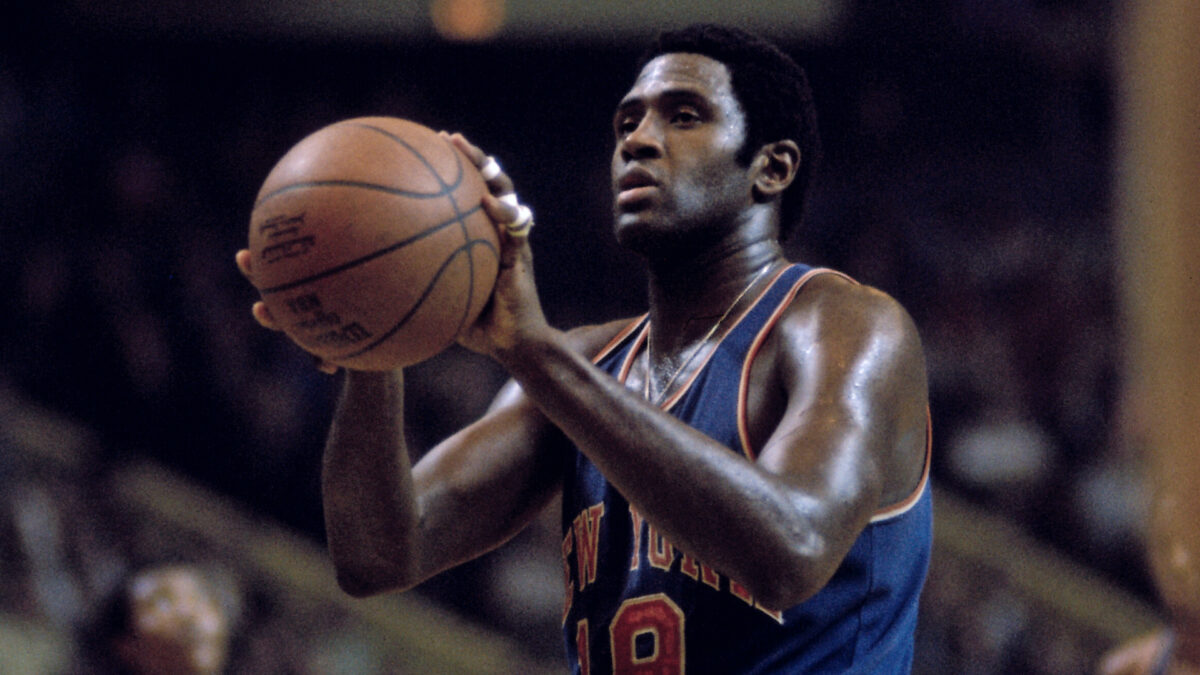
The New York Knicks have one of the strongest, most loyal fanbases in the world. Despite their struggles, you can always see the Madison Square Garden packed every single game with their fans rooting through thick and thin.
Believe it or not, a lot of that should be credited to Willis Reed. Playing power forward, the left-handed Reed was an unstoppable scorer and the Knicks leader during their most successful tenure. Even after his days as an NBA player, Reed served the game as an executive en route to the Naismith Memorial Basketball Hall of Fame. That’s why today, we’re going to honor him and let you know all there is about him.
Willis Reed – Early Years
Born in Hico, Louisiana, Reed was the only child of industrial laborer Willis Reed Sr. and domestic worker Inell Ross Reed. He grew up on his grandfather’s farm in Bernice, a small segregated rural community in northern Louisiana, where he spent most of his time playing sports, hunting, and fishing. The place was so tiny, that Reed once said that “they didn’t even have a population.” Even so, he always stood up for his athletic traits and dominant game.
Willis Reed – High School Hoops
Reed was a multisport athlete when he was a teenager. He played football, baseball, ran track, and threw the show put, besides being a basketball standout. He was already over six feet tall by the time he reached the eighth grade and earned the starting center spot on the West Side High School team when he reached the tenth grade.
The young, tall big man led his high school to the state championship in both football and basketball, turning a lot of heads in the state and learning that he could turn his game into a college education. His parents always put academic excellence ahead of sports, and Reed claimed that it was that discipline that helped him stay on the right path during his days in college.
Willis Reed – College Career
He was such a great athlete that he was actually recruited to play football at Grambling State University. However, fortunately for the NBA, he chose to play basketball for coach Fred C. Hobdy instead, enticed by their fast-paced offense.
During his days in college, Reed earned All-American honors twice, helping them win the National Association of Intercollegiate Athletics (NAIA) Championship during his freshman year. Thanks to his contributions, his Alma Mater won three Southwestern Athletic Conference Championships, being called up for Team USA to play in the Pan American Games. He left college with 2,280 points scored, averaging 26.6 points and 21.3 rebounds during his senior year.
Notably, Reed often shied away from controversies and political activism as he was afraid of losing his athletic scholarship. The complicated political landscape of the 60s saw plenty of his colleagues from Grambling State, an HBCU, get into legal turmoil; but Reed rather focused entirely on sports, which led to some criticism. Even so, he was a beloved member of the community and even a member of the Phi Beta Stigma fraternity. He graduated in 1964 with a minor in biology and a B.A. in P.E, working to become a physical education instructor and teacher.
Willis Reed – Making NBA History With The New York Knicks
It didn’t take long before Reed’s game put the Madison Square Garden on notice. He put on a show against the Lakers with a 46-point masterpiece, the second-highest scoring total for a Knicks rookie. He ranked among the league’s leaders in both points per game and rebounds per game, getting the first of many All-Star appearances in his very first season in the league. Reed joined a Knicks team that was used to be bottom-feeders and immediately turned them around. Moreover, Reed proved to be an all-time great clutch playoff performer right out of the gate, averaging north of 27 points per game in his very first trip to the postseason. Even so, the New York squad still struggled to get past its rivals.

The Knicks’ turnaround came when they let go of head coach Dick McGuire and hired William “Red” Holzman as their new boss. Under that new head coach, the Knickerbockers got past their woes of the seasons earlier, finally getting a winning record at the end of the campaign.
Under coach Holzman, Reed moved to the PF spot to play next to Walt Bellamy, showing signs of great promise. Even so, it wasn’t until they traded Bellamy mid-season to get Dave DeBusschere that the Knicks found their ultimate one-two punch in the frontcourt. Reed continued to excel and make annual appearances in the All-Star Game, and his great performances finally translated into some success for New York.
With DeBuschere’s scoring ability, Reed clogging the paint, and Walt Frazier playing suffocating on-ball defense, the New York Knicks became the best defensive club in the Association, holding their rivals to a league-worst 105.2 points per game by the 1968-69 regular season. The next year, they established franchise records with an 18-game winning streak and their very-first 60+ win season. Reed was named MVP that season.
With him leading the way, the Knicks captured their first and second NBA championship, the only two they have up to this day. From his very first game until his latter season, he made the Knicks a true championship contender and the strongest team in the Atlantic Division.
Willis Reed – NBA Finals And Beating The Los Angeles Lakers
Following his MVP campaign in the 1970 regular season, the Knicks got past the Baltimore Bullets and Milwaukee Bucks in the playoffs to complete their turnaround by reaching the NBA Finals. They would go on to face their toughest task yet, squaring off against a Los Angeles Lakers team featuring Elgin Baylor, Jerry West, and Wilt Chamberlain. The Knicks appeared to be doomed.
He missed Game 6 with a severe thigh injury and all signs suggested he wasn’t going to be available for the most important game of the season. Then, despite the early indication, Reed led his team to their first NBA title with a game for the ages, scoring just four points but inspiring his teammates to fight through the struggles to get the win in seven games. He won MVP, All-Star Game MVP, and Finals MVP in the same season.
The following season, the Knicks were still one of the best teams in the league but failed to reach the Finals. Then, Reed struggled with tendinitis in his left knee during the 1971-72 campaign. That injured knee prohibited him from playing all but 11 games in the season, despite playing without pain in the weeks early in the season. Even so, they still made it to the Finals, the Knicks slipped in the Finals against the Lakers.
Then, in 1973, he would finally win his second championship. The Knicks won 57 games, even though his scoring averages drastically plummeted. he still helped them beat the Bullets and Boston Celtics in the playoffs before facing off with the Lakers in the Finals again. After losing the first of the series, his team won four straight to win their second NBA championship.
Willis Reed – Post-Playing Career
After retirement, Reed started a very successful career as a coach and executive. He coached the Knicks for little more than one year, amassing a 49-47 record. He later became the head coach AT Creighton University from 1981 to 1985 and volunteered as an assistant for St. Jonh’s University. Then, he served as an assistant coach for both the Atlanta Hawks and Sacramento Kings.
He later joined the New Jersey Nets to serve as their coach, and despite an unimpressive 33-77 record, he was appointed as the Nets General Manager and President of Basketball Operations. He put together one of the best teams in the East with the additions of Kenny Anderson, Derrick Coleman, and Drazen Petrovic, plus the appointment of Chuck Daly as their coach. During his tenure, the Nets made it to back-to-back FInals in 2002 and 2003. Finally, he served as a senior vice president of basketball operations with the New Orleans Hornets from 2004 to 2007.
/cdn.vox-cdn.com/uploads/chorus_image/image/70285070/89026622.0.jpg)
Willis Reed – Awards And Accolades
Over the years, he made it to seven All-Star Games with one All-Star Game MVP. He earned All-NBA honors five times (one First Team, four Second Teams). He was elected to the NBA All-Defensive First Team, won Rookie of the Year, made the All-Rookie Team, won one MVP, and was a part of the 50th Anniversary Team and 75th Anniversary Team.
Reed also won the gold medal in the 1963 Sao Paulo Pan American Games with Team USA. On top of that, he won 2 NBA Championships and was named NBA Finals MVP twice. The Knicks retired his no. 19 jersey and he was inducted into the Naismith Memorial Basketball Hall of Fame, the college basketball Hall of Fame, and the NAIA Hall of Fame.
How Much Is Willis Reed Worth?
According to Celebrity Net Worth, Willis Reed has a net worth of $5 million. Nonetheless, that doesn’t seem to be accurate, as he made $3,645,077 through just five years in the NBA, and has earned way more as a coach and an executive over the years. His true net worth is undisclosed.
When was Willis Reed drafted?
Despite being a legend in New York, he admitted that he wanted to play for the Detroit Pistons. Somehow, he slipped all the way to the second round, where the ever-struggling Knicks took him with the 8th-overall pick of the 1964 NBA Draft. Reed was reportedly teaching an eighth-grade gym class and he was quite disappointed by not being taken in the first round.
When did Willis Reed retire?
Willis Reed retired in 1974 after being able to make just 19 appearances in the regular season. His career was cut short with injuries but he still managed to crack the top 10 in nearly every major stat in Knicks franchise history.
What was Willis Reed’s injury?
Even though he was dominant and electric on both ends of the floor, Willis’ career was often plagued by injuries. His two biggest injuries were some tendinitis in his knee, and a major thigh injury sustained after the 1970 Eastern Conference Finals.


